
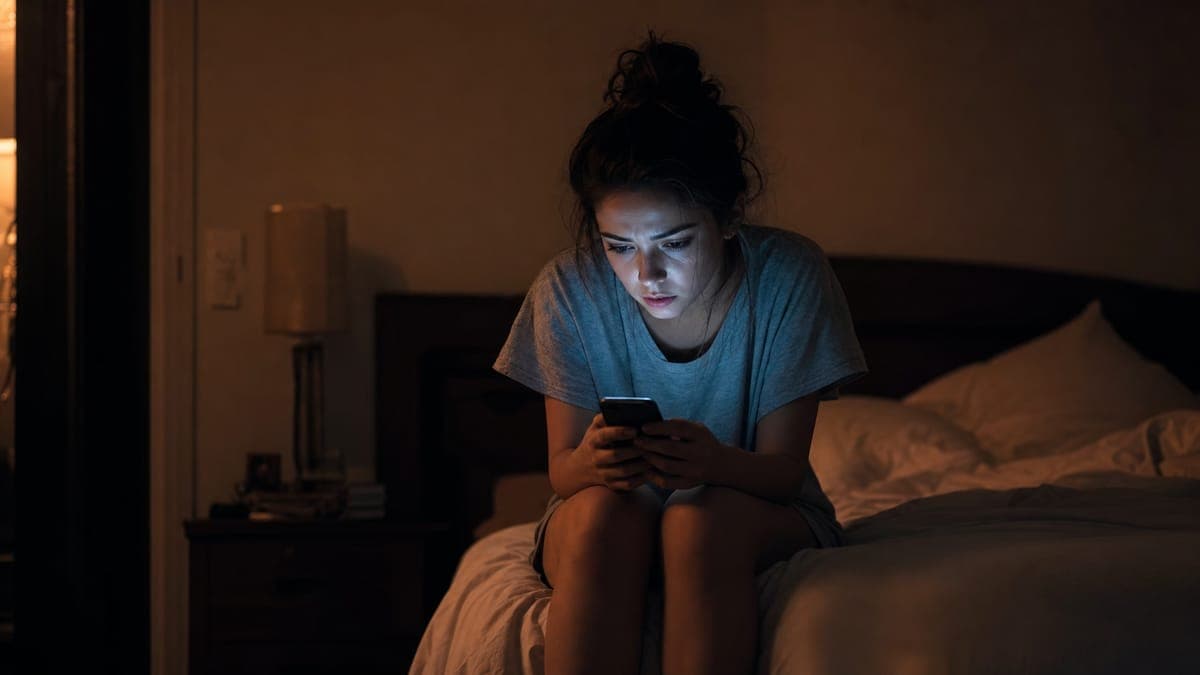
You send the text. It shows "Delivered." Then, a minute later, it shows "Read." And then nothing. You check again ninety seconds later, like the screen might have changed something. You reread your last message three times, hunting for a tone you didn't mean, a phrase that might have landed wrong. By the fifteen-minute mark you've mentally drafted an apology for something you're not even sure you did. By the hour mark, you've half-written a breakup text you'll never send.
If this is familiar, you're not being dramatic and you're not "too much." This is one of the most common, least talked-about forms of relationship distress, and it has a name and a real mechanism behind it: text anxiety, sometimes called texting anxiety. It's the specific panic that shows up while waiting for a reply from someone you're attached to, and it can hijack your focus, your mood, and your day, even when, rationally, you know the relationship is fine.
This isn't a general fear of texting or of phones. It's narrower and more specific than that: it's what happens in the gap between sending and hearing back, when your brain has no information and desperately wants some. Understanding exactly why that gap feels unbearable is the first step to making it feel more survivable, and there are real, specific things you can do the next time it happens, not just "try to relax."
What Text Anxiety Actually Is
Text anxiety in relationships is the acute stress response triggered by an unanswered or ambiguous message from a partner, driven by the combination of an information vacuum (text strips out tone and context), intermittent reinforcement (replies arrive unpredictably, which trains the brain to check compulsively), and, for many people, attachment-system activation (the nervous system treats relational ambiguity as a threat signal). It shows up as racing thoughts, repeated phone-checking, rereading old messages for hidden meaning, catastrophizing about what the silence means, and physical symptoms like a tight chest or restless energy. It is distinct from general phone anxiety or social anxiety, and it can affect people with no other anxiety symptoms at all, because it's tied specifically to attachment, not to technology or socializing in general.
Some version of this shows up in most relationships at some point. It becomes a meaningful problem when it's frequent, intense, disproportionate to what's actually happening, or when it's driving behavior (excessive checking, monitoring, testing your partner) that's straining the relationship rather than protecting it.
The Psychology Behind It: Why Waiting Feels So Bad
Three mechanisms are usually doing the work here, often at the same time.
Intermittent reinforcement: your brain is playing a slot machine
This is the single biggest driver, and it's also the most counterintuitive one. If your partner replied instantly every single time, you wouldn't develop compulsive checking behavior, because there would be no uncertainty to resolve. It's precisely because replies come back on an unpredictable schedule, sometimes in ninety seconds, sometimes in three hours, that your brain learns to treat checking itself as rewarding. This is the same variable-ratio reinforcement schedule B. F. Skinner identified as the most powerful pattern for creating persistent, hard-to-break behavior, and it's the exact mechanism that makes slot machines so much more compelling than a vending machine that reliably gives you what you paid for. Every time you check and there's finally a reply, your brain gets a small dopamine hit that reinforces the checking, not just the relief. That's why it doesn't feel like something you're choosing to do. It's a conditioned loop.
Attachment activation: why some people spiral harder than others
Attachment theory describes how early relationships teach your nervous system what to expect from closeness, and those expectations get quietly replayed in adult relationships, especially under ambiguity. If you lean toward anxious attachment, a delayed or short reply doesn't register as neutral information, it registers as a potential threat to the bond itself, and your nervous system responds accordingly: heightened vigilance, urgency, and a pull toward checking or reaching out again for reassurance. People with more secure attachment tend to interpret the same silence more neutrally ("they're probably busy") without much conscious effort, because their nervous system isn't scanning for abandonment cues in the first place. This is genuinely a difference in how the nervous system processes ambiguity, not a difference in how much two people love their partner. For a deeper breakdown of this pattern, see our anxious attachment style guide.
Rumination and catastrophizing: the story your mind writes to fill the gap
Text removes tone of voice, facial expression, and context, the exact signals your brain normally relies on to judge whether someone is upset, busy, distracted, or fine. In that gap, minds don't tend to sit in "I don't know," they fill it, usually with the worst available story. This is rumination: circling the same worry ("did I say something wrong") without resolution, and catastrophizing: jumping from a delayed reply to a much larger conclusion ("they're losing interest") without evidence in between. Research on rumination consistently finds that interpersonal situations are among the most common triggers, which makes an unanswered text from someone you're attached to an unusually potent spark for this pattern.
There's also a physiological layer underneath all of this. Waiting activates the body's threat-detection system, and studies measuring cortisol around phone and text interactions have found real, measurable stress hormone responses to both receiving and anticipating messages. Repeated phone-checking during that wait doesn't calm the nervous system down, it keeps cortisol elevated by continually re-triggering the alert, which is part of why checking again "just to look" so rarely actually helps you feel better.
Why Am I Like This? A Quick Self-Diagnostic
Not all text anxiety comes from the same place, and figuring out which category you're in changes what actually helps. Be honest with yourself here rather than picking whichever answer feels less uncomfortable.
It's a general anxious attachment pattern if:
- This happens with most people you're close to, not just this one partner, and has for a long time
- You feel it even in relationships where your partner is consistent, communicative, and has never given you a real reason to doubt them
- The intensity of your reaction doesn't track with how long the silence actually is; even a short gap can trigger a full spiral
- You've noticed the same pattern in friendships or with family, not just romantic partners
It's situational anxiety if:
- It started or intensified after a specific event: a recent fight, a partner mentioning they're unhappy, a period of instability
- It's tied to a specific context (a stressful week, a recent breakup you're still recovering from, a new relationship where trust hasn't built yet)
- It tends to ease once the underlying situation resolves or as the relationship gets more established
- You don't experience this kind of anxiety in other areas of your life or other relationships
It may be a legitimate relationship concern, not just internal anxiety, if:
- The unresponsiveness is a consistent pattern, not an occasional busy day, and it's paired with vague or absent explanations afterward
- Your partner is active elsewhere (posting, active on other apps, replying to others) while leaving you unanswered for long stretches, repeatedly
- Raising it gently gets met with defensiveness, dismissal, or blame rather than a real conversation
- You notice other signs of inconsistent effort or stonewalling beyond just texting, like canceling plans without rescheduling or going quiet during actual conflict
These aren't mutually exclusive, and it's genuinely common to have some anxious attachment tendencies and be dating someone who is a bit inconsistent, which makes the anxiety harder to untangle. But the honest distinction matters: if it's mostly the first or second category, the highest-leverage work is on your own coping skills. If it's clearly the third, the work is a direct conversation about the pattern, not more self-soothing techniques layered on top of a real problem.
The Next 10 Minutes: An In-the-Moment Coping Toolkit
When the spiral starts, you don't need a philosophy, you need something to do right now. These are ordered roughly by how fast they work.
- Name it out loud or in writing. Literally say or type: "I'm anxious because they haven't replied and my brain is telling me something is wrong." Naming the feeling moves activity from the more reactive parts of the brain to the more regulated, verbal ones, and it's one of the fastest ways to take the edge off a spike.
- Put the phone somewhere you can't see the screen. Not on silent next to you, actually out of sight, another room if you can manage it. Every glance at the screen re-triggers the checking loop and keeps cortisol elevated. Out of sight breaks the cycle mechanically, before you've even resolved the underlying feeling.
- Set a 10-minute timer before you're allowed to act. Not to text again, not to check their socials, not to reread the thread. Ten minutes feels arbitrary but it's enough time for the acute wave of urgency to crest and start to fall, because anxiety spikes are time-limited even when they don't feel like it in the moment.
- Do the fact vs. story split. On paper or in your notes app, write the literal fact ("no reply in ninety minutes") next to the story you've attached to it ("they're losing interest") and then write one equally plausible alternative ("they're in a meeting" or "their phone died"). This doesn't erase the feeling, but it interrupts the automatic leap from fact to catastrophe, which is often enough to lower the intensity a notch.
- Give your body something else to process. A short walk, splashing cold water on your face, or even 90 seconds of slow exhale-longer-than-inhale breathing genuinely shifts your nervous system out of alarm faster than continuing to sit with the phone in your hand. This isn't a platitude, slower exhales activate the parasympathetic nervous system directly.
- Redirect attention to something that requires real focus. Rumination thrives on idle attention. A task that actually demands concentration, cooking, a work problem, a conversation with someone else, interrupts the loop more effectively than trying to will yourself to stop thinking about it.
- Decide, don't drift. After the ten minutes, make an actual choice: send one calm, low-pressure message ("hey, no rush, just checking in when you get a sec"), or consciously decide the evidence doesn't warrant a message right now. Both are valid outcomes. What keeps the anxiety alive is neither choosing, just continuing to check and reread indefinitely.
Breaking the Pattern Long-Term
The in-the-moment toolkit handles today's spiral. These habits are what actually shrink how often and how hard it hits over time.
- Track your triggers for two weeks. Write down what preceded each spike: time of day, what the message said, how long the gap was. Most people find a smaller, more specific set of triggers than they expected (often workday afternoons, or right after a slightly flat-sounding message), which makes the pattern feel more manageable and less like a constant, undefined threat.
- Build a genuine "elsewhere." Anxiety fills idle time disproportionately. This isn't about distraction as avoidance, it's about having a life full enough that a two-hour gap in texting doesn't become the main event of your afternoon. People with more going on outside the relationship consistently report lower relationship anxiety, not because they care less, but because their sense of self isn't entirely tethered to the phone.
- Practice tolerating the ambiguity on purpose, in small doses. Deliberately wait fifteen minutes before checking a message you know is sitting there, and notice that the discomfort peaks and then recedes on its own. This is a form of gradual exposure, and it works the same way it does for other anxiety patterns: repeated evidence that the feared outcome doesn't happen is what actually recalibrates the nervous system, not reassurance alone.
- Separate the urge to check from the need to act on it. You don't have to stop the urge, that's not realistic. The goal is a gap between noticing the urge and automatically obeying it. That gap is where all of the actual change happens.
- Talk to your partner about your specific triggers, not just "I get anxious." Vague disclosure is hard for a partner to act on. Specific disclosure ("slow replies during the workday are the hardest for me") gives them something concrete they can actually adjust, if they choose to.
- If it's tied to attachment, work on the attachment pattern directly, not just the texting symptom. Texting anxiety is often the most visible symptom of a broader anxious attachment pattern, and working on the underlying pattern, through therapy, reading, or structured self-work, tends to reduce texting-specific anxiety as a side effect, more reliably than trying to manage each individual spiral.
Reassurance-Seeking That Helps vs. Reassurance-Seeking That Backfires
Not all reaching out is equal, and this is one of the most important, least understood distinctions in managing text anxiety. Reassurance can genuinely help build security, or it can quietly feed the anxiety loop, depending almost entirely on timing, frequency, and what's actually being asked.
| Reassurance-seeking that helps | Reassurance-seeking that backfires |
|---|---|
| Sent once you're calm, after the 10-minute pause | Sent mid-spiral, while still activated |
| States the feeling directly ("I noticed the gap and my brain went to a worst-case place, no pressure to respond fast") | Disguises the anxiety as something else, or sends a passive-aggressive or guilt-inducing message |
| Asks for something specific and reasonable ("can we do a quick check-in tonight?") | Asks a vague, unanswerable question ("do you still love me?") that can't actually resolve the anxiety |
| Happens occasionally, tied to an identifiable spike | Happens after nearly every gap in replies, regardless of context |
| Accepts the answer once given, even if it takes a while to arrive | Requires repeating the same reassurance multiple times before it "counts" |
| Builds trust over time because your partner can see it's proportionate | Trains both of you that anxiety is the only thing that gets a fast response, reinforcing the cycle |
| Comes with self-soothing already attempted first | Is the first and only coping strategy used |
The uncomfortable truth about reassurance is that it works instantly and unreliably in the long run. Getting reassurance genuinely lowers anxiety for minutes to hours, but it also teaches your brain that the anxious spiral was accurate and dangerous, and that only reassurance from someone else could resolve it, which makes the next wave arrive faster and stronger. This doesn't mean never ask for reassurance. It means noticing when reassurance-seeking has become the only tool in the box, and building the others alongside it.
If You're the Partner on the Other Side
If you know your partner experiences text anxiety, small choices on your end genuinely change how intense it gets for them, without requiring you to be tethered to your phone.
What tends to make it worse:
- Going fully silent for hours with no context, especially if this is a shift from your usual pattern
- Being vague when asked about it later ("I was just busy") instead of a real, brief explanation
- Treating their anxiety as an overreaction or something to just "get over," rather than a real physiological response
- Inconsistency, replying instantly some days and disappearing for hours on others with no pattern, which is exactly the unpredictability that intensifies the anxiety loop
- Reading the message and not responding for a long stretch while clearly active elsewhere (visible on social media, replying to others), without any acknowledgment
What actually helps:
- A five-second heads-up beats silence every time: "in a meeting, talk later" costs you nothing and closes the information gap that fuels the entire spiral
- Basic consistency in response patterns, even if the pattern is "I'm slow to reply most weekdays," because predictability, even imperfect predictability, is what the anxious brain is actually starving for
- Taking it seriously without over-accommodating; you don't need to reply within two minutes forever, you need to be honest, consistent, and willing to talk about the pattern
- Asking directly what would help, rather than guessing, since the specific triggers vary a lot person to person
- Not weaponizing it during conflict; going quiet as a way to "win" an argument does real damage to someone with this pattern and is worth naming as off-limits between you
Long Distance Makes This Harder, on Purpose
If you're in a long distance relationship, text anxiety usually hits differently, and often worse, because distance removes almost every one of the in-person signals that would otherwise soften an unanswered message: a hand on your back, a facial expression across the room, the simple fact of someone's physical presence telling your nervous system everything is fine. When text and calls are most or all of what you have, an unanswered message isn't one data point among many, it's often the only information available, so your brain overweights it dramatically.
This is also why LDR anxiety tends to spike specifically around communication gaps rather than around distance itself. A few quiet hours between two people who live together barely registers. The same few quiet hours between two people who haven't seen each other in weeks can feel enormous, not because the relationship is weaker, but because there's nothing else filling in the picture. For a fuller breakdown of how distance affects this specifically, see our guide to long distance relationship anxiety, and for practical scripts on staying connected across time zones and busy schedules, see our communication tips for long distance couples.
The most useful shift for LDR couples specifically isn't more texting, it's more low-effort, non-conversational presence. A quick mood update, a "thinking of you" that doesn't require a reply, a shared sense of what the other person's day looks like, all of these narrow the information gap without adding to the pressure of needing to compose a perfect, reassuring message every time.
Common Mistakes People Make
- Checking the phone repeatedly, which feels like doing something but actually keeps the stress response activated rather than resolving it.
- Rereading the last message over and over looking for hidden tone, which almost always manufactures meaning that wasn't there.
- Sending a sharp or guilt-inducing follow-up while still activated, which tends to create the exact distance it was trying to prevent.
- Testing your partner by going quiet yourself to see if they notice, which turns the relationship into a system of mutual monitoring instead of open communication.
- Treating every slow reply as equally significant, without factoring in context like their schedule, time zone, or a day you already know is unusually busy for them.
- Never naming the pattern to your partner at all, which leaves them guessing at what's actually going on and unable to help even if they'd genuinely want to.
- Relying only on reassurance-seeking as a coping strategy, without building any of the self-regulation skills that make the anxiety smaller over time.
Best Practices Worth Building Into Daily Life
- Agree on a rough communication rhythm together, rather than assuming your preferred pace is the correct one for both of you.
- Use the 10-minute pause as a default rule before reacting to any unanswered message, not just the bad ones.
- Keep a running list of your specific triggers so you can catch the pattern earlier each time, before it fully spirals.
- Build in low-effort ways to signal presence to each other that don't require a full conversation, especially during busy stretches.
- Revisit the self-diagnostic above periodically; what's driving the anxiety can shift over the life of a relationship, and the right response shifts with it.
When to Talk to a Therapist
Occasional text anxiety is common enough to be considered a normal, if uncomfortable, part of modern relationships, and most people can meaningfully reduce it with the coping strategies above. It's worth talking to a therapist if the anxiety is frequent, intense, and hard to interrupt even with active effort; if it's driving compulsive checking or monitoring behavior that's damaging trust or taking up hours of your day; if it's showing up as a broader pattern across most of your relationships, not just this one; or if it's accompanied by other anxiety symptoms, panic attacks, or a persistent low mood that isn't improving. A therapist, particularly one trained in CBT or attachment-based approaches, can help you build the underlying regulation skills more directly than any single article can, and can also help sort out whether what you're experiencing is anxiety, a response to a genuinely inconsistent partner, or some combination of both. This is a health-related decision worth taking seriously rather than pushing through indefinitely, especially if it's affecting your sleep, work, or day-to-day functioning.
How Lovebae Helps
Lovebae wasn't built to cure anxiety, and it won't do the deeper regulation work that a therapist or your own coping practice can. What it's specifically built to do is shrink the information vacuum that fuels this exact loop, since so much of text anxiety comes from having zero signal about what's actually happening on the other end.
- Mood sharing lets your partner tap once to show how they're actually doing, so a quiet stretch doesn't have to be interpreted from nothing. Instead of guessing from silence, you can see "tired" or "good day" without either of you needing to compose a message.
- Heart taps are a two-second, no-reply-required way to say "thinking of you" in the middle of a busy day, which closes part of the gap that a fully unanswered text leaves open, without adding pressure on your partner to stop and write something back.
- Home screen widgets show your partner's status or mood at a glance, so checking in doesn't require opening the app, starting a conversation, or waiting on a reply at all.
- Daily check-ins and streaks build the kind of small, predictable rhythm of contact that research links to lower relationship anxiety, more reliably than one long, occasional conversation.
- Love letters give an anxious moment somewhere real to go, write it out fully, send it, and be heard, instead of a rapid-fire text sent mid-spiral that you might regret later.
- Countdown timers are especially useful for long distance couples, turning a vague, anxiety-inducing "someday we'll see each other" into a concrete, visible date.
None of this replaces the internal work of building tolerance for ambiguity, and it's not a substitute for an honest conversation if the anxiety is pointing at something real in the relationship. But for the specific, narrow problem of "I have no information and my brain is filling the gap with worst-case stories," low-effort presence signals genuinely help, because they give your nervous system something real to work with instead of nothing at all.
You don't have to choose between constant texting and constant worry. Join the Lovebae waitlist and build a rhythm of small, low-pressure check-ins that actually closes the gap anxiety lives in.
Frequently Asked Questions
Why do I panic when he doesn't text back? Your brain treats an unanswered text as a small, unresolved threat, and it doesn't have enough information to close the loop, so it fills the silence with worst-case stories. This is intensified by intermittent reinforcement, the same unpredictable-reward pattern that makes slot machines compelling, and if you lean anxious in attachment, the ambiguity of a delayed reply can activate the same alarm system that responds to actual relationship threats. It's a real physiological response, not an overreaction you're choosing.
Is texting anxiety a form of anxious attachment? Not always, but the two are closely linked. Anxious attachment specifically amplifies texting anxiety because it makes ambiguous signals feel like evidence of abandonment. But texting anxiety can also show up situationally, for example after a fight, in people who don't have an anxious attachment style at all. If the panic is intense, frequent, and shows up across most of your relationships, it's more likely a broader attachment pattern worth exploring.
How long should I wait before double texting? There's no universal rule, but a useful gut check is whether the second message provides new information or is really a bid for reassurance in disguise. If you notice you're about to send a second message just to get a reaction, wait at least an hour and use the in-the-moment coping steps first. A calm follow-up sent once you're regulated reads very differently than one sent mid-spiral.
Why does waiting for a text make me anxious even when the relationship is good? Because the anxiety is often not really about your partner's behavior, it's about your nervous system's response to an information gap. Text strips out tone, facial expression, and context, so even in a genuinely secure relationship, silence has room to be misread.
Is it a red flag if my partner doesn't text back for hours? Occasional slow replies are rarely a red flag on their own, especially from someone who is otherwise consistent and follows through. It becomes a legitimate concern when it's a consistent pattern paired with vague explanations, defensiveness when raised gently, or a broader pattern of inconsistent effort.
What is left on read anxiety? It's the specific spike of distress that comes from seeing a read receipt with no reply following it. It tends to feel worse than simply not knowing if a message was seen, because the read receipt removes the benefit of the doubt, replacing it with the more painful interpretation that they saw it and chose not to respond.
Can a relationship app actually help with texting anxiety? It can help reduce one specific driver, the information vacuum, without resolving anxiety as a whole. Apps like Lovebae are not a treatment for anxiety and won't replace therapy if the pattern is severe, but low-effort presence signals can shrink the ambiguous silence that the anxious brain otherwise fills with worst-case stories.
Related Reads
- Long Distance Relationship Anxiety — the broader anxiety picture for couples apart, including trust and visit-day nerves
- Anxious Attachment Style Guide — understand the deeper pattern behind the panic
- Communication Tips for Long Distance Couples — practical scripts for staying connected across distance
- 150 Flirty Texts for Couples — for when you want to text from a calm, connected place instead of an anxious one
- How to Overcome Frustration in Your Long Distance Relationship — for when anxiety curdles into resentment

